
If your home has a chimney and you're seeing a roof leak, there's a 70% chance the leak is at the chimney. The chimney is the single most common failure point on every roof we inspect across Northeast Ohio.
Here's why chimneys leak so reliably, what specifically fails, and how to figure out if you need a roofer or a mason.
Why Chimneys Leak More Than Anything Else on a Roof
Three structural reasons:
**1. The chimney protrudes through the roof.** Every penetration through a roof is a potential leak point. The chimney is the largest, most complex penetration on most homes — it requires four sides of flashing, two different transition geometries (vertical brick to angled roof), and counter-flashing that has to be embedded in the brick mortar joint.
**2. Different materials expand at different rates.** The chimney brick expands and contracts with temperature differently than the asphalt shingles around it. Over thousands of freeze-thaw cycles, that differential opens gaps at the flashing seams.
**3. Standing water and snow.** Snow piles up on the upslope side of the chimney. A "cricket" — a small peaked structure that diverts water around the chimney — is required by code on chimneys wider than 30 inches but is missing on many older homes.
The Five Chimney Leak Sources, Ranked
After inspecting thousands of chimneys in Lake, Geauga, Ashtabula, Cuyahoga, Summit, and Mahoning counties, here's how chimney leaks break down:
**1. Failed step flashing (40% of cases).** The L-shaped pieces of flashing that interleave with the shingles along the side of the chimney. They pull away from the brick over time — caulk dries out, fasteners corrode, ice expands the gap. Water enters at the brick-to-flashing seam and runs down inside the roof.
**2. Failed counter-flashing (25%).** The metal flashing embedded in a mortar joint of the chimney brick. When the joint cracks (freeze-thaw) or the flashing rusts, water enters here and travels down behind the step flashing.
**3. Cracked or missing chimney crown (15%).** The concrete or mortar cap on top of the chimney. When it cracks, rain falls directly into the chimney flue, runs down the brick, and emerges at the roof line.
**4. Cracked brick or failed mortar joints (10%).** Especially common on chimneys 50+ years old. Water absorbs into the brick, freezes, expands, and breaks the brick face. Over time, water finds a path through.
**5. Missing cricket on a wide chimney (10%).** Code-required on chimneys wider than 30 inches but missing on many older Ohio homes. Snow accumulates on the upslope side, melts during the day, refreezes at night, and forces water under the shingles.
Roofer or Mason — Which Do You Need?
The decision tree:
**Call a roofer first.** Most chimney leaks are roof-related, not chimney-related. Step flashing, counter-flashing, and cricket installation are all roofer's work. A roofer can also identify whether masonry work is also needed.
**Call a mason if** the roofer identifies cracked brick, failed mortar joints, or a damaged crown. The mason rebuilds the masonry; the roofer then re-installs the flashing.
**Call both for big jobs.** A 50-year-old chimney with failed flashing AND cracked brick AND a damaged crown needs both trades. We coordinate this work and bring in our preferred mason when needed.
We do all the flashing work and the cricket installation. We don't do brick repair or crown replacement — those are specialty masonry skills that take a dedicated career to do well.
How to Find the Exact Leak Point
Most homeowners assume the leak is wherever the water is dripping inside. That's almost never true. Water enters at one point on the roof, runs along framing or sheathing, and exits at the lowest point that allows it to drop. The actual entry can be 10+ feet away from the visible drip.
The reliable way to find the entry point is a water test:
1. On a dry day, run a hose at the chimney from below and slowly upward
2. Have someone inside the attic with a flashlight, watching the chimney area
3. Note exactly where water first appears inside
4. Move the hose progressively higher up the chimney until the leak appears
This identifies whether the leak is at the base flashing, the side flashing, the counter-flashing, or higher up at the crown. A 10-minute water test saves hours of guesswork.
What Repair Typically Costs
In Northeast Ohio:
- **Re-caulking deteriorated flashing seams (cosmetic):** $200–$500 (buys 1–3 more years)
- **Replacing step flashing on one side of chimney:** $400–$900
- **Full re-flashing (step + counter-flashing on all four sides):** $800–$2,000
- **Adding a cricket to a wide chimney:** $600–$1,500
- **Crown rebuild (mason):** $400–$1,200
- **Full chimney re-build (mason):** $3,000–$15,000+
We generally recommend full re-flashing on chimneys that have been leaking, rather than spot-repairing. The cost difference between fixing one side and re-flashing all four is small, and once one side fails, the other three are usually within 2–3 years of failing.
When Re-Flashing Happens During a Roof Replacement
If you're replacing the whole roof, full chimney re-flashing is included in our standard scope. New step flashing, new counter-flashing if accessible, sealants at brick joints, and a cricket on chimneys over 30 inches wide. Adding all of that to a roof replacement adds maybe 1–2 hours of work per chimney and is dramatically cheaper than coming back later.
Signs Your Chimney Is About to Leak (Before It Does)
Watch for:
- Visible rust on metal flashing
- Cracked or missing caulk where flashing meets brick
- White efflorescence (salt deposits) on the brick — sign of moisture absorption
- Spalling brick (pieces flaking off the face)
- Cracked mortar joints
- Damp patches on attic framing near the chimney, even if no interior staining yet
- Water staining on the wall directly below an interior chimney
A free chimney inspection from us takes 30 minutes and identifies whether you have a few months or a few years before the next leak.
Free Inspection
Call (440) 645-2003 or request a free chimney inspection. We document with photos, identify the failure mode, and give you a written estimate for repair or full re-flashing. We also tell you honestly when masonry work is needed and refer to a mason we trust.
About the Author
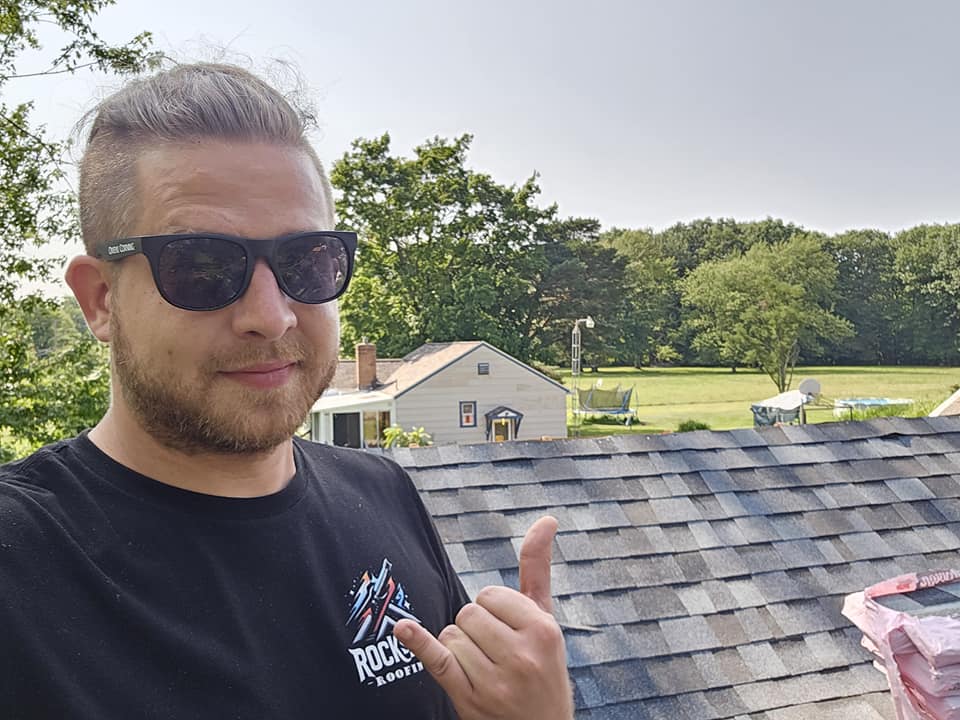
Mike Ende — Founder, Rockstar Roofing LLC
Mike Ende has 9+ years of Northeast Ohio roofing experience and founded Rockstar Roofing LLC in 2024. He is an Owens Corning Duration installer, BBB A-rated, fully insured, and personally answers the phone at (440) 645-2003. Based in Ashtabula, OH, Mike serves homeowners across Ashtabula, Lake, Geauga, Cuyahoga, Summit, and Mahoning counties.
Read Mike’s full story →This article was last reviewed and updated on May 17, 2026 by Mike Ende, founder of Rockstar Roofing LLC.