
Ohio is unusual among states. We don't license residential roofing contractors at the state level — there's no Ohio Roofing License Board. But every municipality in our service area requires a permit for most roofing work. The two facts confuse a lot of homeowners.
Here's what's actually required across Northeast Ohio, what happens if you skip a permit, and what to ask your contractor before signing.
When You Need a Permit
The general rule across Northeast Ohio: any roof replacement (full tear-off and re-roof) requires a permit. Most repair work under a defined dollar threshold ($500–$2,500 depending on the city) does not.
Specific situations that always require a permit:
- Full or partial roof replacement (any tear-off-and-replace work)
- Structural deck repair (replacing OSB or plywood beyond a small isolated section)
- Adding or modifying skylights
- Changing the roof pitch or structure
- Adding solar panels
- Installing roof-mounted HVAC equipment
- Any work over a defined dollar amount (varies by city)
Situations that typically don't require a permit:
- Spot shingle repairs covering less than 25% of a slope (in most cities)
- Replacing failed pipe boots or single sections of flashing
- Cleaning gutters
- Tarp installation for emergency mitigation
The dollar thresholds matter and vary city to city. In Mentor, repairs under $1,000 typically don't need a permit. In Cleveland Heights it's $500. In Ashtabula it's higher. We pull permits where required and tell you when they're not.
What a Permit Actually Does
Three things:
1. **Code inspection.** A municipal building inspector verifies the work meets local code — proper underlayment, ice and water shield where required, ventilation specs, deck-replacement quality. Catches both honest mistakes and contractor cost-cutting.
2. **Public record.** The permit is filed with the city. Future buyers can pull it. Title companies look for them on resale.
3. **Insurance protection.** Your homeowner's insurance can deny claims for work performed without a required permit. We've seen storm-damage claims denied because the underlying roof was installed without proper permitting two years earlier.
Typical Permit Costs Across Northeast Ohio
Permit fees are charged by the municipality, not by the contractor. Typical ranges:
- **Ashtabula:** $50–$120
- **Mentor:** $100–$200 (varies by job size)
- **Painesville:** $75–$150
- **Willoughby:** $100–$175
- **Chardon:** $85–$150
- **Cleveland:** $100–$250
- **Solon:** $125–$250
- **Cleveland Heights:** $100–$200
- **Akron:** $100–$200
We include the permit cost as a separate line item in every estimate so you can verify what's being charged is what's being paid to the city.
What Voids Your Insurance When You Skip a Permit
Three patterns Ohio insurance carriers cite when denying claims:
**Code-required upgrades not present.** If a 2023 roof replacement was supposed to include ice and water shield extending to a specific point per local code, but no permit was pulled and the inspector never verified, and a 2026 ice dam causes interior damage at that exact location — the carrier may deny the interior claim citing "improperly installed roof system."
**Unpermitted structural work.** If the roof deck was rotted in three places and got patched without the proper structural review and permit, a future structural failure can be denied.
**Loss of "standard of care" defense.** Most insurance policies require that work on the home meet "standard of care" for the locality. Skipping required permits can be argued as falling below that standard.
The denials aren't automatic — adjusters look at the specific facts of each claim. But the risk is real and measurable. A $150 permit you didn't pull becomes a $20,000 claim denial.
Resale Implications
When you sell your home, the buyer's title company often runs a permit history. An open or missing permit creates a red flag that can:
- Delay closing while resolved
- Require buyer to re-pull and re-inspect after closing (cost shifts to seller)
- Cause buyers to walk if the permit history shows multiple issues
- Trigger price reductions during negotiation
A clean permit history adds nothing to the home value, but a problematic one can cost thousands.
Who Pulls the Permit
Ohio law allows either the homeowner OR the contractor to pull a roofing permit. In practice, **the contractor should pull it.** The contractor has the technical information the application requires (square footage, materials, manufacturer specs), they're already on-site for the inspection, and their name on the permit creates accountability if anything fails inspection.
If a contractor refuses to pull permits or asks you to pull them yourself "to save money" — that's a red flag. The savings are imaginary (you still pay the fee) and you've taken on liability that should be theirs.
What to Ask Your Contractor
Five questions before you sign:
1. **Do you pull all required permits?** Answer should be yes for any replacement.
2. **Is the permit cost itemized in the estimate?** Yes — should appear as a separate line.
3. **Do you handle the inspection?** Yes — the contractor should meet the inspector.
4. **What happens if the inspection fails?** A reputable contractor remediates at their cost.
5. **Will you provide a copy of the closed permit when work is done?** Yes — every permit closes after final inspection. You should receive a copy.
If a contractor stumbles on any of those, get another quote.
Code Items the Inspector Actually Checks
In Northeast Ohio, the most-cited inspection items are:
- **Ice and water shield extends from the eave a minimum specified distance.** Most local codes require it 24 inches past the heated wall line; quality installs go six feet up.
- **Drip edge present at all eaves and rakes.** Required by IBC/IRC.
- **Underlayment present and correct grade.** Synthetic underlayment is standard now.
- **Proper nail count and pattern.** 4 nails per shingle minimum, 6 in high-wind zones.
- **Ventilation provides 1 sq ft of net free area per 150 sq ft of attic.**
- **Flashing material and method correct.** Step flashing vs. continuous, counter-flashing at chimneys, etc.
Failing any of these results in a callback — the contractor returns and corrects the work, then re-inspects.
What Happens If You Get Caught Without a Permit
Three possible outcomes:
1. **Stop-work order.** The city can require all work to halt until a permit is pulled.
2. **Double permit fee.** Many cities charge double the normal fee for after-the-fact permit applications.
3. **Tear-off requirement.** In severe cases, the inspector can require the new roof be torn off so the work can be properly inspected from the start.
The risk of getting caught is real — neighbors call, drone photographers spot work in progress, and nearly every city has a permit-tracking system that flags work without permits.
Free Estimate That Includes Permit Costs
Every estimate we provide includes the permit fee for your specific city as a separate line item. We pull the permit, coordinate the inspection, and provide the closed permit document at job completion.
Call (440) 645-2003 or request a free estimate. 9+ years working with municipal building departments across Ashtabula, Lake, Geauga, Cuyahoga, Summit, and Mahoning counties.
About the Author
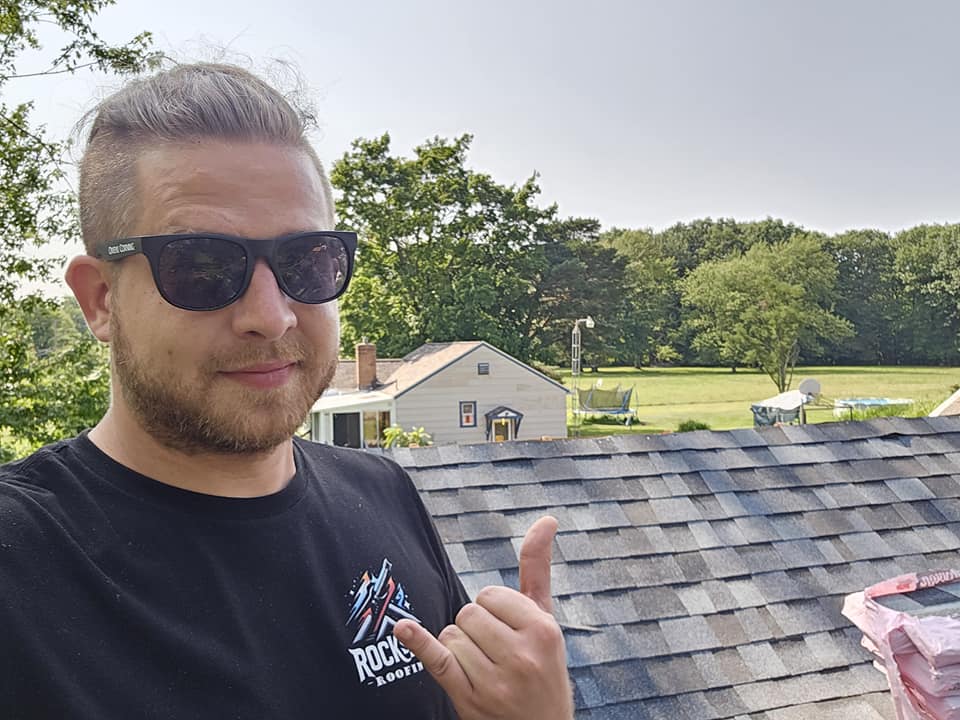
Mike Ende — Founder, Rockstar Roofing LLC
Mike Ende has 9+ years of Northeast Ohio roofing experience and founded Rockstar Roofing LLC in 2024. He is an Owens Corning Duration installer, BBB A-rated, fully insured, and personally answers the phone at (440) 645-2003. Based in Ashtabula, OH, Mike serves homeowners across Ashtabula, Lake, Geauga, Cuyahoga, Summit, and Mahoning counties.
Read Mike’s full story →This article was last reviewed and updated on May 18, 2026 by Mike Ende, founder of Rockstar Roofing LLC.